


Inspired by the story of Eulalia Glanville and the lost Elizabethan play Page of Plymouth.
By Fiona Benson
Welcome to Elizabethan Plymouth! This writing walk invites you back in time to a thriving port town busy with craftspeople, sailors, traders, privateers and merchants.
This walk is inspired by the earliest known literary work to mention Plymouth – an Elizabethan play by Ben Jonson and Thomas Dekker, Page of Plymouth, which was commissioned by the Rose Playhouse in London in 1599. The play retold the true story of a young girl from the Plymouth area called Eulalia Glanville, and although that play has been lost, we can reconstruct its plot from historical records, popular ballads, and its account in a true crime pamphlet of the day, ‘Sundrye Strange and Inhuman Murthers, lately committed’.
We begin at The Merchant’s House. Its first recorded owner was a merchant and privateer called William Parker. He was a close friend of Francis Drake, and probably served under him in the battle of the Spanish Armada. He led raids against the Spanish in the Caribbean and in 1601 struck lucky, capturing a pair of treasure ships carrying 10,000 gold ducats.
He was consequently made Lord Mayor of Plymouth and used his loot to build this timber-framed house with its jettied upper floor and its leaded light windows. Perhaps Eulalia Glanville lived in a house not unlike this one….
Writing Warm-up: Drawing With Words
Explore Merchant’s House; peer in its windows; get nosy. Find one small detail and describe it as closely as you can. This could be a crack in a window pane, a bit of moss, a back gate, a single brick, an abandoned chair inside, a scratch on the timber… pay close detailed attention. Write as freely as you can without self-editing and get loose (this ‘free-writing’ approach is recommended throughout).
Writing Prompt: “Narrow Prying Neighbours”
In Elizabethan times this area would have been built up and crowded. It would have been easy to overhear or spy on what your neighbours were up to. In the Elizabethan play The Lamentable and True Tragedy of M. Arden of Feversham in Kent, 1592, the female protagonist Alice complains that she can’t meet freely with her lover because “my narrow-prying neighbours blab”. Court depositions (a kind of witness statement) of the time also speak of this kind of hearsay and quarrel in close quarters:
…[ Mrs Culliford] speaking to this deponent’s said mother, told her that she was a whore and a carrier’s whore, and that a carrier had lain with her on a bulk and broken her back and that one of her sons (naming the youngest save one) was a carrier’s bastard. This was the language she gave this deponent’s said mother at the time in the open street, wherein the meantime many people passed to and fro…
Case 20, Defamation in the Butcher’s Shop, deposition 7
What quarrels and gossip has this house overheard or, conversely, if you look into the house, what can you see or overhear happening inside it? What ghosts are rattling about in there?
Next stop
The Elizabethan Gardens.
Walk south down St Andrews Street until you meet Notte Street. Turn left and walk East for 0.1 miles until you hit Southside Street. Turn right down Southside Street – you will see the famous Plymouth Gin Distillery ahead of you. This building was originally a Dominican monastery, founded in 1431 (hence the Blackfriars of the street beside it, Blackfriars Lane). Following the dissolution of the monasteries the building was recorded as a debtor’s prison, a Marshalsea and one of the first non-conformist meeting spaces in the area. Eulalia may well have known its walls.
Continue past the distillery down Southside Street and take your second right turning down Pin Lane. At the end of Pin Lane turn left down New Street. In a few steps you will find the Elizabethan Gardens on your left.
1. Eulalia's World
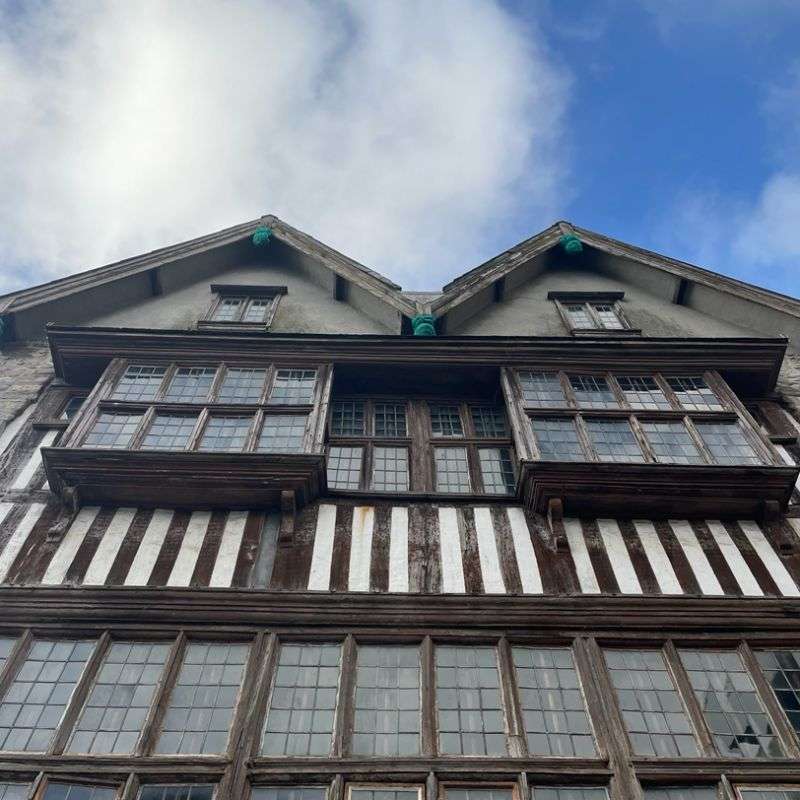
The Merchant’s House
PL1 2AX
Located at 3 Barley Market Street between Finewell Street and St Andrews Street
The Elizabethan Gardens is a series of four small walled gardens, from which you can see the backs and chimney stacks of several of the surrounding Elizabethan houses. You’ll find a knot garden, a water garden, a rose garden and a lawn garden. Note the 1630 doorway brought from the Hospital of the Poor’s Portion. Elizabethans would have relied on their gardens not only for food but for medicine and prophylactics.
Eulalia Glanville was rumoured to have thwarted her own pregnancies, and might have used herbs such as dittander, pennyroyal and mugwort to provoke miscarriage. She is also suspected of trying to poison her husband; herbs recommended as emetics at the time included stonewort mixed with white wine, and hellebore. Here is a Jacobean remedy for insomnia (note the opium!)
32. To provoke sleep
But if any of the family be troubled with too much watchfulness, so that they cannot by any means take rest, then to provoke the party to sleep you shall take of saffron a dram dried, and beaten to powder, and as much lettuce seed also dried, and beaten to powder, and twice as much white poppy seed beaten also to powder, and mix these with woman’s milk till it be a thick salve, and then bind it to the temples of the head and it will soon cause the party to sleep; and let it lie on not above four hours.
The English Housewife: Containing the inward and outward virtues which ought to be in a complete woman … 1615 Gervase Markham, ed. Michael R. Best
Writing Prompt: “Saffron a Dram Dried”
The language of these remedies and herbal spells is a lovely mix of the floral and the practical. What plants can you find in the Elizabethan Garden? Do you know their names? If not, what would you call them? What do you imagine their healing (or poisoning) properties to be, and why?
Write a recipe or spell that involves some of the plants you find. What is it for? Is it a love charm or a hex, a remedy for worry or a poultice for aching bones? How should your reader prepare and combine the herbs? Are there any ritual actions they should take as they make their tincture?
Next stop
The Elizabethan House
Continue down New Street towards the harbour. You will find The Elizabethan House a few buildings down on your right.
2. Eulalia's Kitchen

The Elizabethan Gardens
34 New Street, The Barbican, Plymouth, PL1 2LA
(check opening times, free entry)
Plymouth was rising in importance as a port and in the late 1500s the Mayor, John Sparkes commissioned this ‘New’ street of housing to accommodate a growing merchant and navy population, and it included the now-called ‘Elizabethan House’. After its mercantile beginnings it changed hands multiple times, and was inhabited by an eighteenth century wigmaker and a nineteenth century washerwoman. By the Victorian period, this house had become a slum dwelling, housing up to fifty-eight people. Slated for demolition, it was spared and turned into a museum in 1930, and then restored in 2021. Each room now tells a story of one of the different inhabitants. Although this was never Eulalia Glanville’s residence, creatively we can imagine her domestic life, and inhabit this house through the lens of the Page of Plymouth story.
As you enter, I invite you to imagine yourself as a person involved in Eulalia Glanville’s story. Look at the dramatis personae list on the next page; which character will you choose to be?
Writing Prompt: Eulalia’s House
Pick a character and explore the house from their perspective. What area of the house are they most familiar with? When and how did they come to this house? What happened for them here? How do they feel about the house and its environs? How do they feel about its inhabitants? What urgent things do they have to say and what stories do they need to tell?
Writing Prompt: My Mother’s Iron
Find an object in the house that draws you in some way. Describe it in detail. What materials is it made from? What was it used for? How does it work? What about it attracts your curiosity? Does it remind you of anything from your own life, past or present? Who do you associate it with?
Next stop
The Mayflower Memorial
Continue down along New Street until you meet The Barbican. Turn right onto the Barbican and walk for a further minute or so till you meet the left turning ‘Pilgrim Way’; you will see the Mayflower Memorial steps ahead.
3. Eulalia at Home

The Elizabethan House
32 New Street, The Barbican, Plymouth, PL1 2NA
(check opening times, ticketed – £7 in 2026)
Eulalia Glanville
Originally from Tavistock, Eulalia falls in love with her father’s apprentice (?) George Strangwidge. However, her parents force her to marry an older, wealthier Plymouth widower, Master Page. She is unhappy in the marriage, takes up again with George Strangwidge and eventually pays two men to murder her husband.
Eulalia Glanville’s Mother
Eulalia’s mother, who lives in Tavistock, is persuaded by Satan to break off her daughter’s relationship with George in order to marry her off to a much wealthier Plymouth widower, Master Page. Her daughter ends up plotting to kill her new husband and ends up hanged for it.
George Strangwidge
George Strangwidge was originally approved to marry Eulalia Glanville, but when he goes away to London her parents marry her off instead to an older, wealthier man – Master Page. On his return George secretly starts seeing Eulalia again, and eventually they plot together to murder Master Page so they can be together.
Gilbert Page
Son of Master William Page from his first marriage, stepson of Eulalia. His father is murdered in the middle of the night in his bedroom. Moves to Barnstaple in 1600. Becomes a significant merchant and mayor of Plymouth.
Master Page
Master Page is described as a widower, and one of the foremost inhabitants of the town.
He marries the younger Eulalia Glanville, but she is already in love with George Strangwidge and is forced into the marriage. She eventually arranges to murder old Master Page in his bed.
Master Page’s Sister, Mistress Harris
Mistress Harris is sent for to come to the house once Master Page has been killed. She finds her brother dead, but also notices the scratch marks around his neck where he tried to tear off the scarf he was being strangled with. She then finds other signs of his murder (that his neck is broken, that his knees are bloody) and sends for the mayor and other respectables to come and witness the murder.
Unnamed Maid
The unnamed maid works for the Page household and lives in. Once Master Page has been murdered, Eulalia wakes her maid to go and see the body. Eulalia knows the man has been killed, but the maid does not.
“she [mistress Page] called her maide, who was not privie to any thing, and had her light a Candle […] sending her maid first into the chamber”
“The maid simply felt on her Maisters face, and found him colde and stiffe and so tolde her mistresse”
Thomas Stone
Thomas Stone is paid to help kill Master Page by George Strangwidge, who is in love with Master Page’s wife, Eulalia Glanville. He comes to the house in the dead of night and helps strangle and break the neck of Master Page. He needs the money for his own wedding, which happens soon after the murder, but is interrupted by his arrest.
August 28. – NOTE OF SHIPS IN THE QUEEN’S PAY
The ships under Sir Francis Drake’s charge: –
The Revenge
Nonpareil
Hope
Swiftsure
Aid
Advice
The Galleon Leicester
Merchant Royal
Roebuck
Edward Bonaventure
Gold Noble
Hopewell
Griffin
Minion
Thomas
Bark Talbot
Spark
The Hope
Bark Bond
Bark Bonner
Bark Hawkyns
Eliz. Founes
Unity
Elizabeth Drake
Bear
Chance
Delight
Nightingale
Small Caravel
Three years before Eulalia’s death Charles Howard, Lord Admiral of England and his second-in-command Francis Drake, famous sea captain and privateer, led British ships in their successful defeat of the invading Spanish Armada from the Sutton Pool harbour of Plymouth. You can look inland from the Mayflower steps across the historic harbour and imagine that frantic mustering and embarkment.
Perhaps Eulalia or some of the other people in her story witnessed the Armada defence with their own eyes. They would certainly have been familiar with the harbour, around which Plymouth commerce centred. The harbour also plays a strange part in the pamphlet version of Eulalia’s story; after her arrest a raven was seen to deliberately hang itself with a rope from a ship’s mast in the harbour, and the ship itself mysteriously turned round…
Writing Prompt: Other strange things seen at that time
What supernatural goings-on might you imagine happening in this harbour environment? What signs and portents might you find? Is there any whisper in the wind of the old lives and crimes that haunt Plymouth?
Writing Prompt: The Naming of the Ships
On this page you’ll find a list from 1588 of the ships recorded as being under Francis Drake’s command. Choose one and think about what kind of person would choose this name for their boat, and why? What were their hopes and fears? How much can a name tell you about its owner – both their private vulnerability and their worldly aspirations. (This might also be a fun writing game to play with the modern yachts in the harbour…)
List taken from State papers relating to the defeat of the Spanish Armada, anno 1588 Navy Records Society (Great Britain); Laughton, 1830-1915)
THE END!
I hope you enjoyed walking and writing with Eulalia through Elizabethan Plymouth.
4. Eulalia's Historical Moment

The Spanish Armada
Mayflower Steps Memorial, The Barbican, Plymouth, PL1 2LR